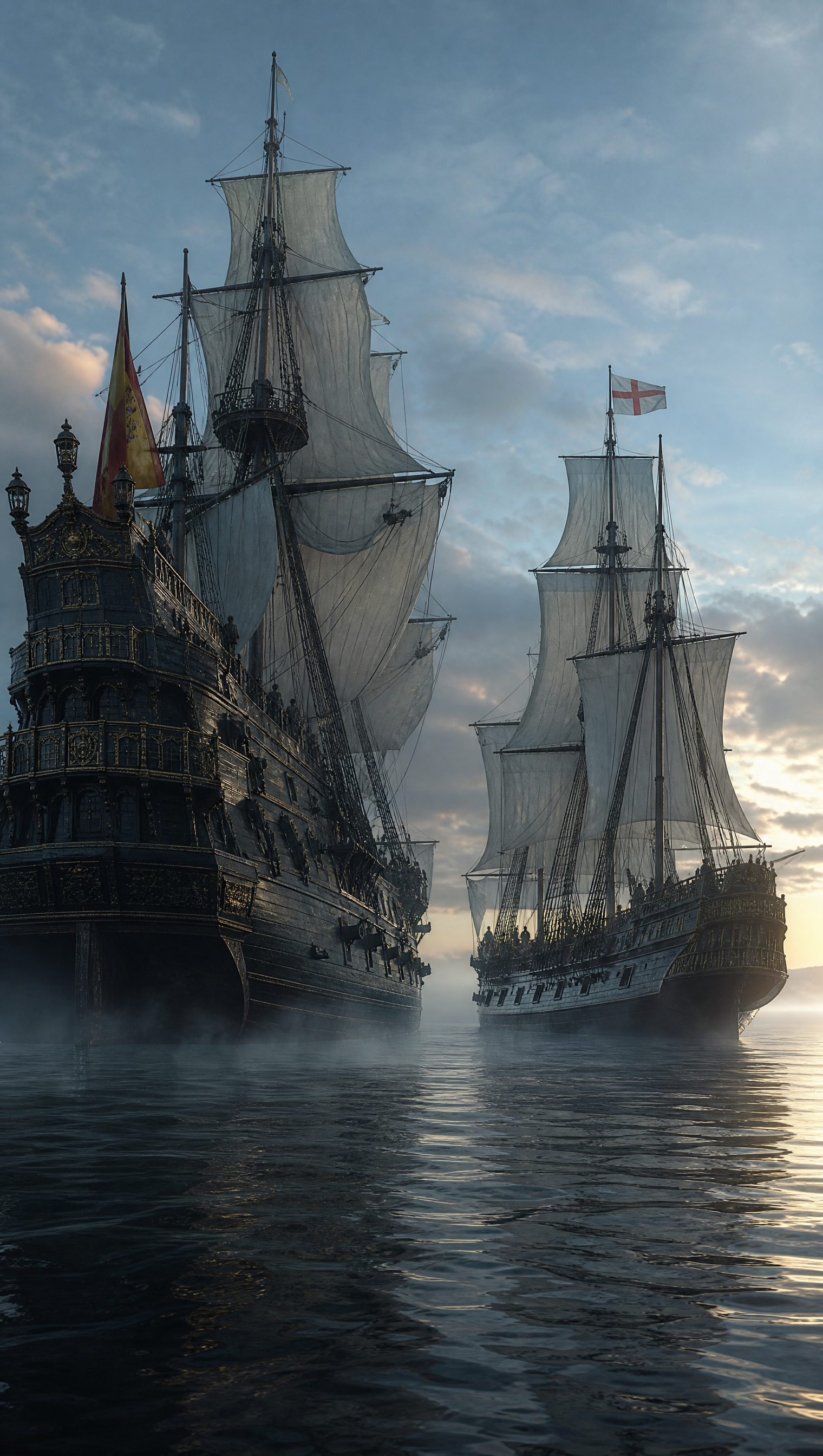
This folio expands the published History video into a library record: the narrative spine, source trail, key still scenes, and reading path. The claim stays narrow: In 1588, Spain sent 130 warships to invade England. The fleet carried more soldiers, more cannons, and more supplies than any navy before it. Spain's galleons were towering, top-heavy fortresses designed for boarding, not long-range gunnery.
01Event
The event is best understood as pressure meeting a specific set of tools and choices.
How did the Spanish Armada lose? In 1588, Spain sent 130 warships against England, with more men, guns, and supplies than anyone. The catch was design: its huge ships were built to board.
02Turning point
The turn arrives when one constraint becomes stronger than every plan around it.
England built lower, faster race-built galleons with long-range cannon. Instead of closing in, they stayed away and kept firing. Then at Calais, fireships drifted into the anchored crescent.
03Mechanism
The mechanism is the hidden hinge: how ordinary constraints turn into an outcome.
That was the trap. Once scattered, the Armada could not regroup, and fierce North Sea storms blocked the Channel route home. The fleet was pushed north around Scotland and Ireland.
04Consequence
The consequence is what remains after the shock has passed.
Meanwhile, Parma's invasion army waited in the Netherlands and never linked up. Spain lost roughly half its ships and thousands of sailors. The Armada failed because size was not enough.
05Sources
- Kings and Generalspublic
- Timelinepublic
- History Vidsresearch_note
06Scene plates






07Further reading
As an Amazon Associate, Avaryn may earn from qualifying purchases.
- The Armada Garrett Mattingly · intro
- The Spanish Armada Colin Martin · deep
- The Safeguard of the Sea: A Naval History of Britain 660-1649 N. A. M. Rodger · extended