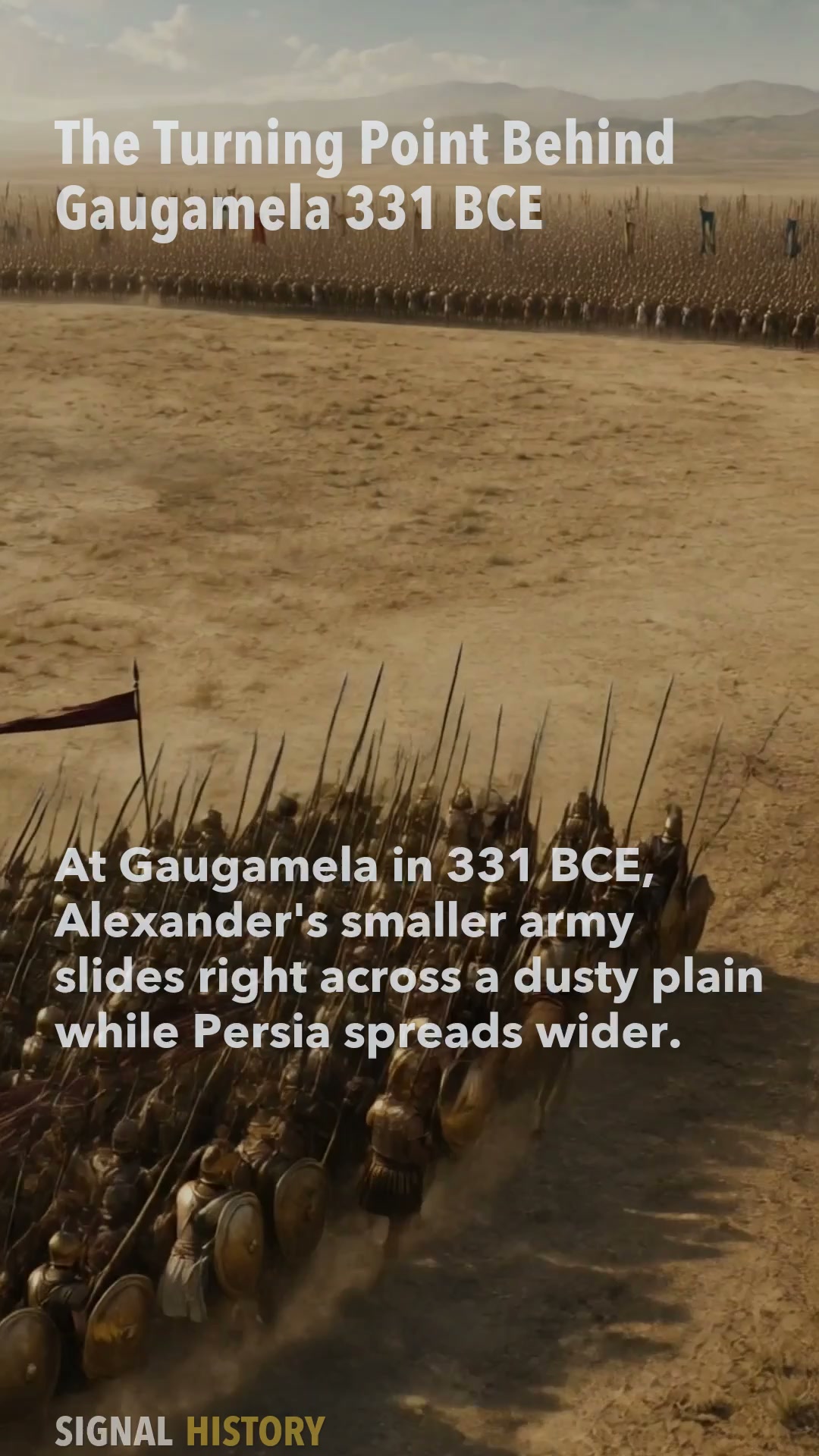
This folio expands the published History video into a library record: the narrative spine, source trail, key still scenes, and reading path. The claim stays narrow: Why win by moving sideways? At Gaugamela in 331 BCE, Alexander's smaller army slides right across a dusty plain while Persia spreads wider. The battle starts turning before the famous charge even begins.
01Event
The event is best understood as pressure meeting a specific set of tools and choices.
Why win by moving sideways? At Gaugamela in 331 BCE, Alexander's smaller army slides right across a dusty plain while Persia spreads wider. The battle starts turning before the famous charge even begins. That huge width looked deadly.
02Turning point
The turn arrives when one constraint becomes stronger than every plan around it.
A straight attack let Persia wrap both flanks. But size carries friction. The wider the line stretched, the harder it became to keep aligned, quick, and under control. So Alexander keeps drifting right.
03Mechanism
The mechanism is the hidden hinge: how ordinary constraints turn into an outcome.
Persia has to follow or risk being outflanked. Its giant line bends, stretches, and thins. Near the center, a narrow seam appears. He is creating the only target he needs.
04Consequence
The consequence is what remains after the shock has passed.
Then the Companion Cavalry punches through that seam and lunges toward Darius. Alexander never needed to crush every soldier. He only needed one place where numbers stopped behaving like strength. That is Gaugamela's lesson.
05Sources
- Historia Civilis Macedonian Battle Tacticspublic
- BazBattles Gaugamela Analysispublic
- Strat Gaming Tactical Simulationsresearch_note
06Scene plates


07Further reading
As an Amazon Associate, Avaryn may earn from qualifying purchases.
- The Landmark Arrian: The Campaigns of Alexander Arrian, edited by James Romm · intro
- Alexander the Great Robin Lane Fox · deep
- The Art of War in the Hellenistic Age Victor Davis Hanson · extended