This folio expands the published History video into a library record: the narrative spine, source trail, key still scenes, and reading path. The claim stays narrow: Wait, Alexander beat an island by building land. At Tyre, the city seemed untouchable: half a mile offshore, ringed by huge walls. The real question was not how to storm it, but how to erase the water.
01Event
The event is best understood as pressure meeting a specific set of tools and choices.
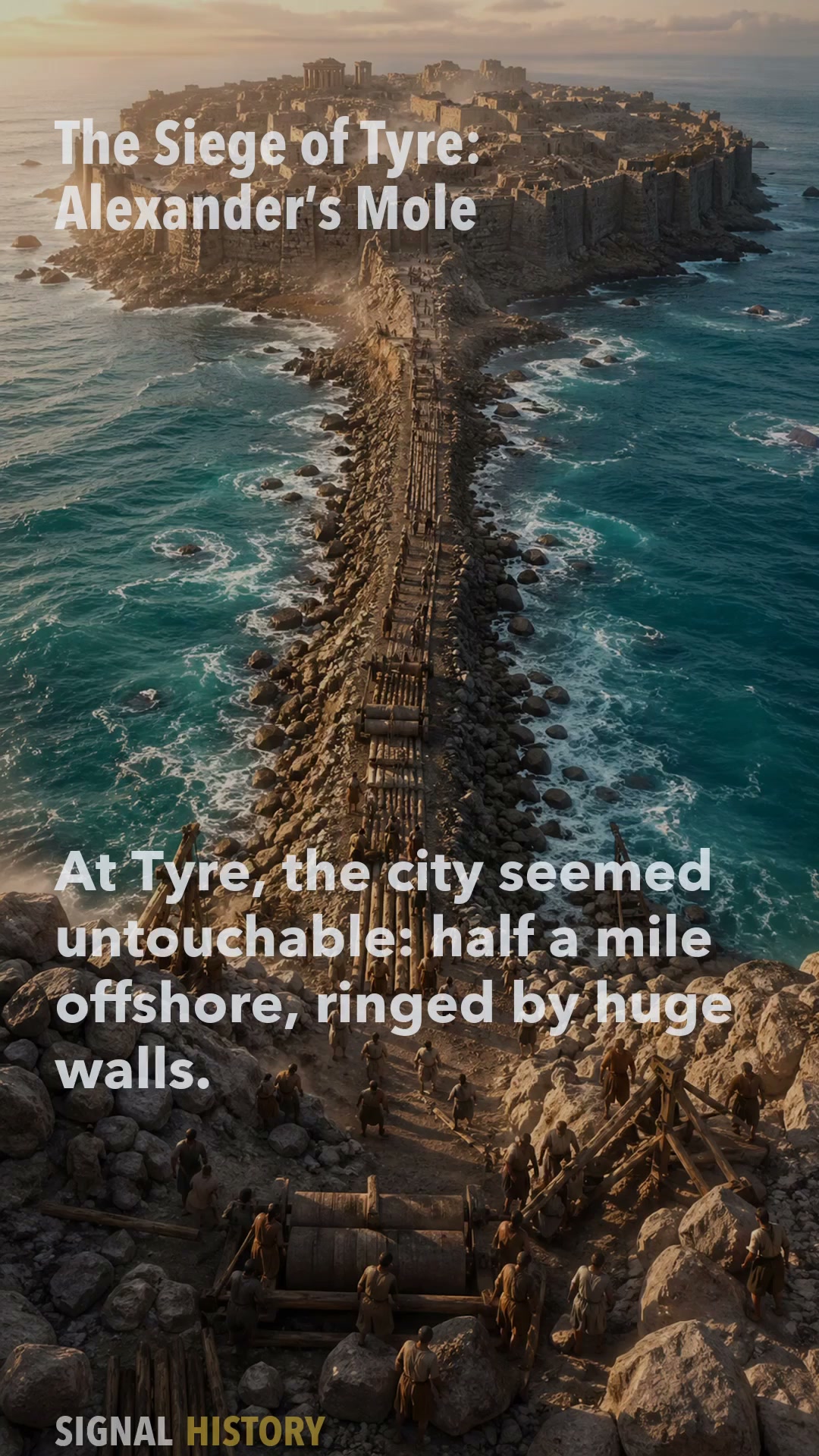
Wait, Alexander beat an island by building land. At Tyre, the city seemed untouchable: half a mile offshore, ringed by huge walls. The real question was not how to storm it, but how to erase the water.
02Turning point
The turn arrives when one constraint becomes stronger than every plan around it.
Alexander lacked the fleet to crack Tyre from the water, so he attacked the map instead. He ordered stone and timber dumped into the channel, making a road where waves had protected the city. Tyre fought back.
03Mechanism
The mechanism is the hidden hinge: how ordinary constraints turn into an outcome.
Fire ships burned the first works, and the sea kept tearing at the pile. So the mole grew broader, tougher, and closer, until siege towers could finally roll within striking distance. That is why Tyre mattered.
04Consequence
The consequence is what remains after the shock has passed.
Alexander did not simply win a siege; he removed the island. The causeway outlived the battle, rewrote the coastline, and proved that engineering can be a weapon.
05Sources
- Kings and Generals: Siege of Tyre 332 BCpublic
- BazBattles: The Siege of Tyrepublic
- The History Guy: Alexander the Great and the Siege of Tyreresearch_note
06Scene plates


07Further reading
As an Amazon Associate, Avaryn may earn from qualifying purchases.
- Alexander the Great Philip Freeman · intro
- The Campaigns of Alexander Arrian · deep
- The Nature of Alexander Mary Renault · extended