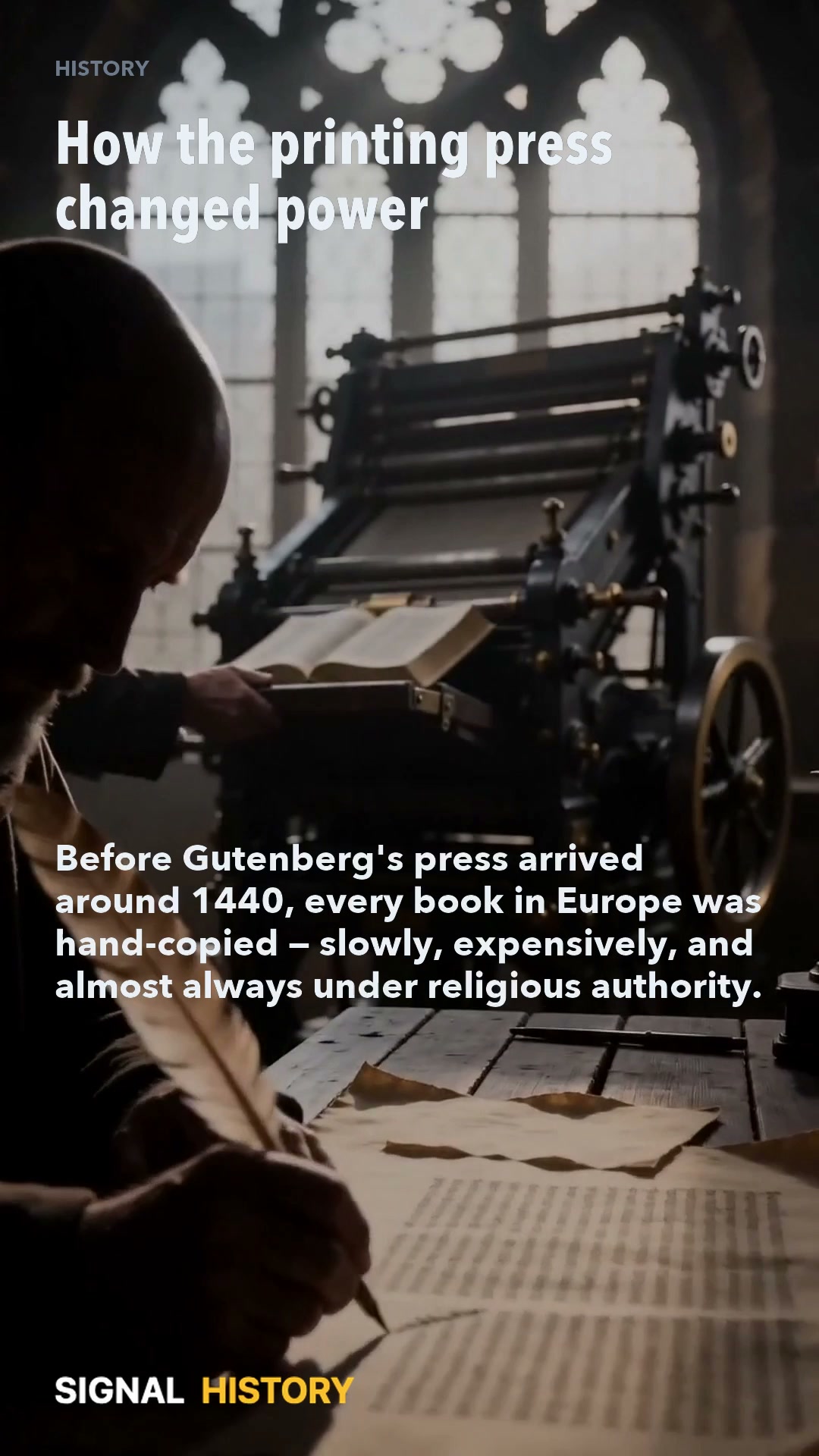
This folio expands the published History video into a library record: the narrative spine, source trail, key still scenes, and reading path. The claim stays narrow: One machine broke the Church's monopoly on truth. Before Gutenberg's press arrived around 1440, every book in Europe was hand-copied — slowly, expensively, and almost always under religious authority. Knowledge belonged to whoever owned the scribes.
01Event
The event is best understood as pressure meeting a specific set of tools and choices.
One machine broke the Church's monopoly on truth. Before Gutenberg's press arrived around 1440, every book in Europe was hand-copied — slowly, expensively, and almost always under religious authority. Knowledge belonged to whoever owned the scribes.
02Turning point
The turn arrives when one constraint becomes stronger than every plan around it.
Gutenberg changed the economics overnight. His press made books eighty percent cheaper within decades. Suddenly merchants, lawyers, and ordinary readers could own ideas that once lived locked inside monastery walls.
03Mechanism
The mechanism is the hidden hinge: how ordinary constraints turn into an outcome.
Martin Luther proved what that meant. In 1517, his challenge to the Catholic Church spread across Europe in weeks — not because he was powerful, but because printers were. No censor could stop thousands of copies.
04Consequence
The consequence is what remains after the shock has passed.
The printing press didn't just spread words. It shifted power from institutions that hoarded knowledge to anyone who could publish an idea. Science, democracy, and revolution all followed the same logic: whoever controls the press controls the future.
05Sources
- Britannicaresearch_note
- National Archivesresearch_note
- Smithsonianresearch_note
06Scene plates


07Further reading
As an Amazon Associate, Avaryn may earn from qualifying purchases.
- The Printing Revolution in Early Modern Europe Elizabeth L. Eisenstein · intro
- The Printing Press as an Agent of Change Elizabeth L. Eisenstein · deep
- The Nature of the Book: Print and Knowledge in the Making Adrian Johns · extended