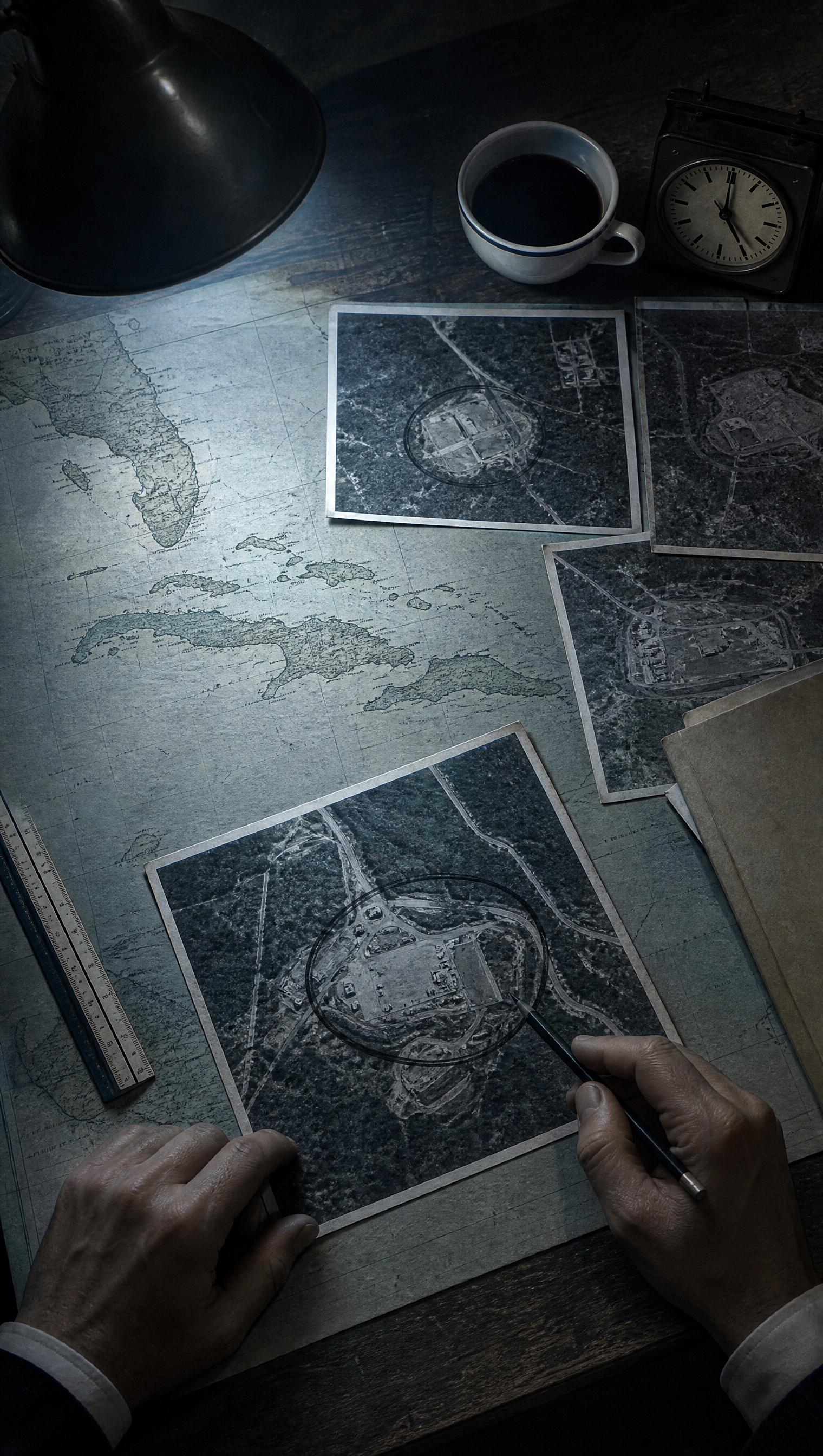
This folio expands the published History video into a library record: the narrative spine, source trail, key still scenes, and reading path. The claim stays narrow: In October 1962, a U-2 spy plane photographed Soviet nuclear missile sites under construction in Cuba, just ninety miles from Florida. Within hours, American analysts confirmed these weapons could strike most major U.S. Cities in under five minutes.
01Event
The event is best understood as pressure meeting a specific set of tools and choices.
Nuclear war nearly started in Cuba because spy photo turned geography into a countdown. In October 1962, Soviet missile sites appeared ninety miles from Florida, close enough to hit U.S. Cities in minutes.
02Turning point
The turn arrives when one constraint becomes stronger than every plan around it.
The obvious move was an airstrike. Kennedy chose a blockade instead, called a quarantine. Because it slowed the crisis without forcing Moscow to answer immediately with its own public escalation.
03Mechanism
The mechanism is the hidden hinge: how ordinary constraints turn into an outcome.
That delay mattered, because control was cracking. Ships, submarines, letters and rumors moved faster than certainty. While backchannel messages searched for an exit before a mistake became irreversible in the dark.
04Consequence
The consequence is what remains after the shock has passed.
The ending was two deals, not one. Soviet missiles left Cuba in public. American missiles left Turkey quietly. The lesson was brutal: survival came from buying time, then saving face.
05Sources
- TED-Ed: The history of the Cuban Missile Crisispublic
- Simple History: The Cuban Missile Crisis (1962)public
- Henry Belcaster: Wtf was the cuban missile crisis??research_note
06Scene plates




07Further reading
As an Amazon Associate, Avaryn may earn from qualifying purchases.
- One Minute to Midnight: Kennedy, Khrushchev, and Castro on the Brink of Nuclear War Michael Dobbs · intro
- Essence of Decision: Explaining the Cuban Missile Crisis Graham Allison and Philip Zelikow · deep
- Managing Nuclear Operations Ashton B. Carter, John D. Steinbruner, and Charles A. Zraket · extended