This folio expands the published History video into a library record: the narrative spine, source trail, key still scenes, and reading path. The claim stays narrow: Caesar got trapped first. That is Alesia. In 52 BCE he besieged a Gallic hill fortress, then a rescue army rose behind him.
01Event
The event is best understood as pressure meeting a specific set of tools and choices.
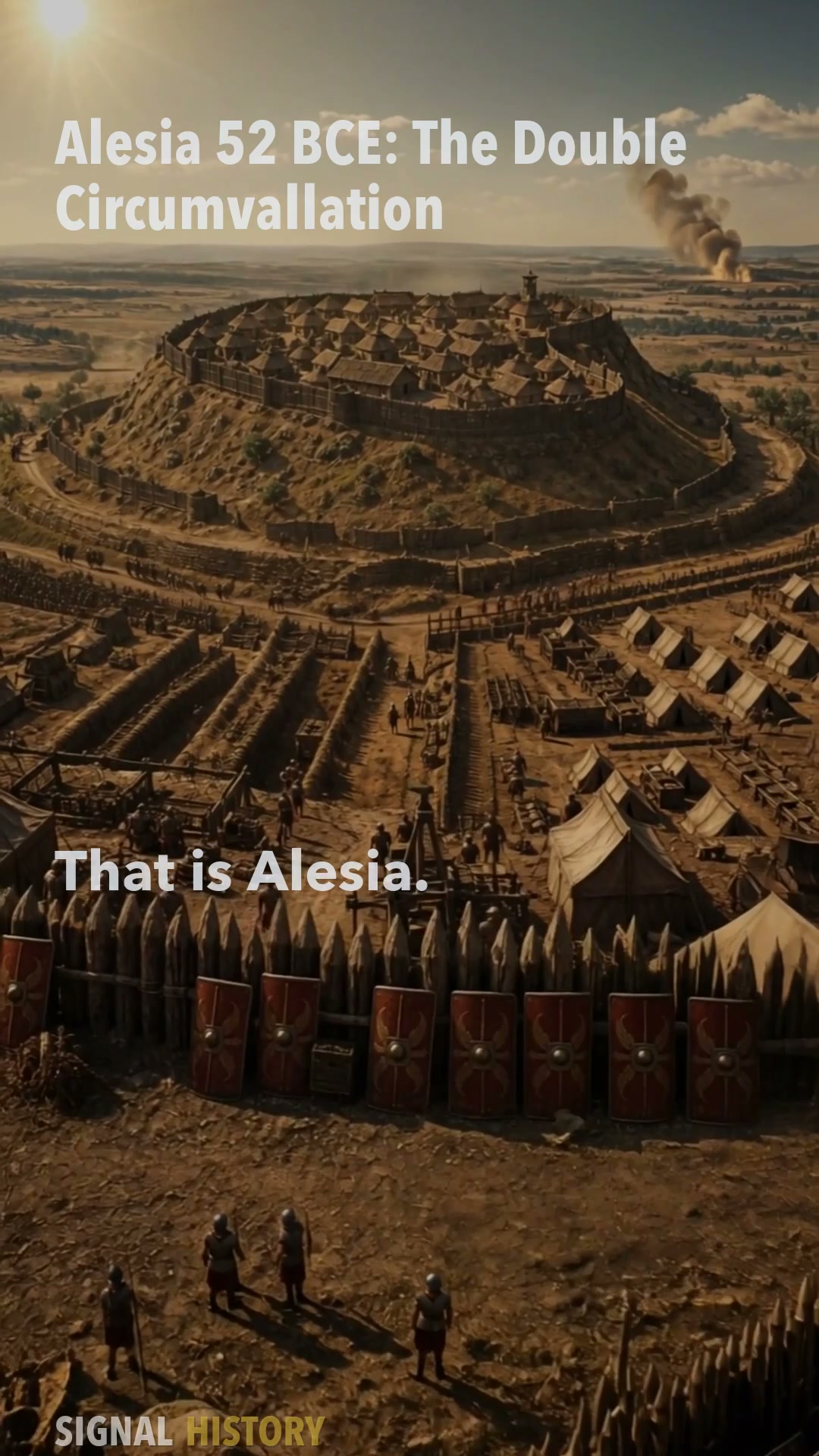
Caesar got trapped first. That is Alesia. In 52 BCE he besieged a Gallic hill fortress, then a rescue army rose behind him. Suddenly the attackers were pinned between enemies on both sides.
02Turning point
The turn arrives when one constraint becomes stronger than every plan around it.
Retreat made sense. Caesar built instead. His soldiers dug trenches and raised timber walls in two rings: one facing inward to choke Alesia, one facing outward to stop the army coming to save it.
03Mechanism
The mechanism is the hidden hinge: how ordinary constraints turn into an outcome.
Then the ground fought for Rome. Traps, towers, and open lanes forced one enemy to break in while the other tried to break out. Caesar turned one battlefield into a machine for fighting both at once. It worked.
04Consequence
The consequence is what remains after the shock has passed.
The relief force failed, Alesia fell, and organized Gallic resistance cracked. The twist is not that Caesar escaped a trap. He won by redesigning the trap, which still feels startlingly modern today.
05Sources
- Historia Civilis: The Battle of Alesia (52 B.C.E.)public
- HistoryMarche: Caesar's Masterpiece - Siege of Alesia, 52 BCpublic
- SandRhoman History: The Battle of Alesia in Contextresearch_note
06Scene plates


07Further reading
As an Amazon Associate, Avaryn may earn from qualifying purchases.
- Caesar: Life of a Colossus Adrian Goldsworthy · intro
- The Landmark Julius Caesar: The Complete Works: Gallic War, Civil War, Alexandrian War, African War, and Spanish War Julius Caesar, edited by Kurt A. Raaflaub · deep
- The Gallic War Julius Caesar, translated by Carolyn Hammond · extended