This folio expands the published Art video into a library record: the narrative spine, source trail, key still scenes, and reading path. The claim stays narrow: Wait, why does Wheatfield with Crows feel trapped? Van Gogh makes open land feel shut. Three paths split, none clearly escape.
01What you see
The visual surface is the first piece of evidence, not decoration.
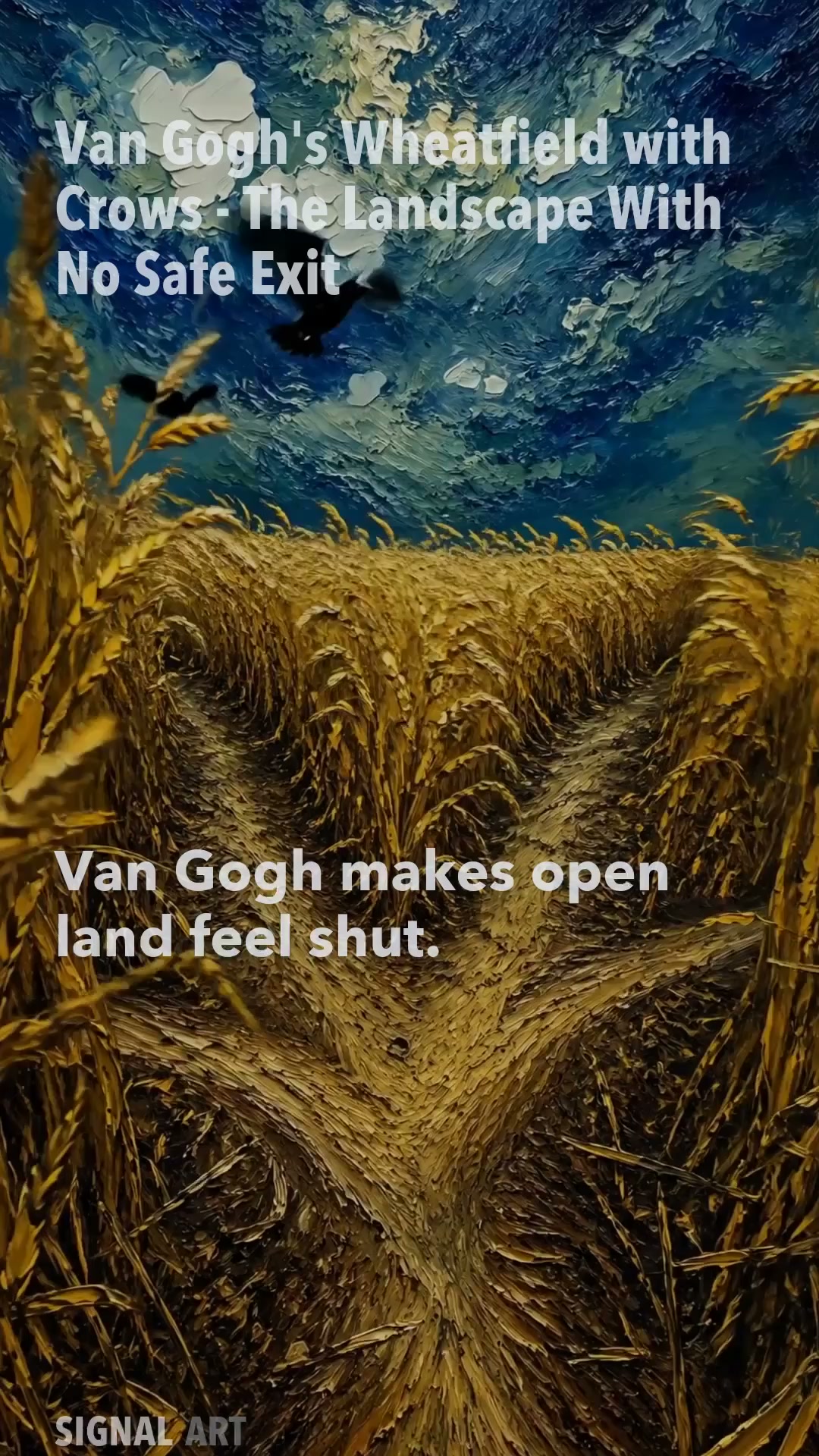
Wait, why does Wheatfield with Crows feel trapped? Van Gogh makes open land feel shut. Three paths split, none clearly escape. Yellow grain surges forward while black crows slash a bruised blue sky.
02What it meant
The section keeps the video's core idea in written form.
That tension is built, not imagined. The horizon sits high and tight. Heavy brushstrokes thicken the field. Hard jumps between yellow, blue, and black kill any calm, so distance feels closer and pressure rises.
03Technique
The section keeps the video's core idea in written form.
Then the context sharpens it. In 1890, near Auvers-sur-Oise, Van Gogh kept painting wheat fields in his final weeks. This one is not a diary entry. It is a visual machine for unease.
04Why it lasts
The section keeps the video's core idea in written form.
That is why the painting still lands. It does not show danger directly. It makes seeing itself feel cornered. The field is outside, but the suspense happens inside you, which is the real trap.
05Sources
- Museum collection or official page - Wheatfield with Crowsmuseum
- Authoritative biography - Vincent van Goghreference
06Scene plates


07Further reading
As an Amazon Associate, Avaryn may earn from qualifying purchases.
- Van Gogh: The Life Steven Naifeh and Gregory White Smith · intro
- Van Gogh in Auvers: His Last Days Martin Bailey · deep
- The Painting of Modern Life: Paris in the Art of Manet and His Followers T. J. Clark · extended