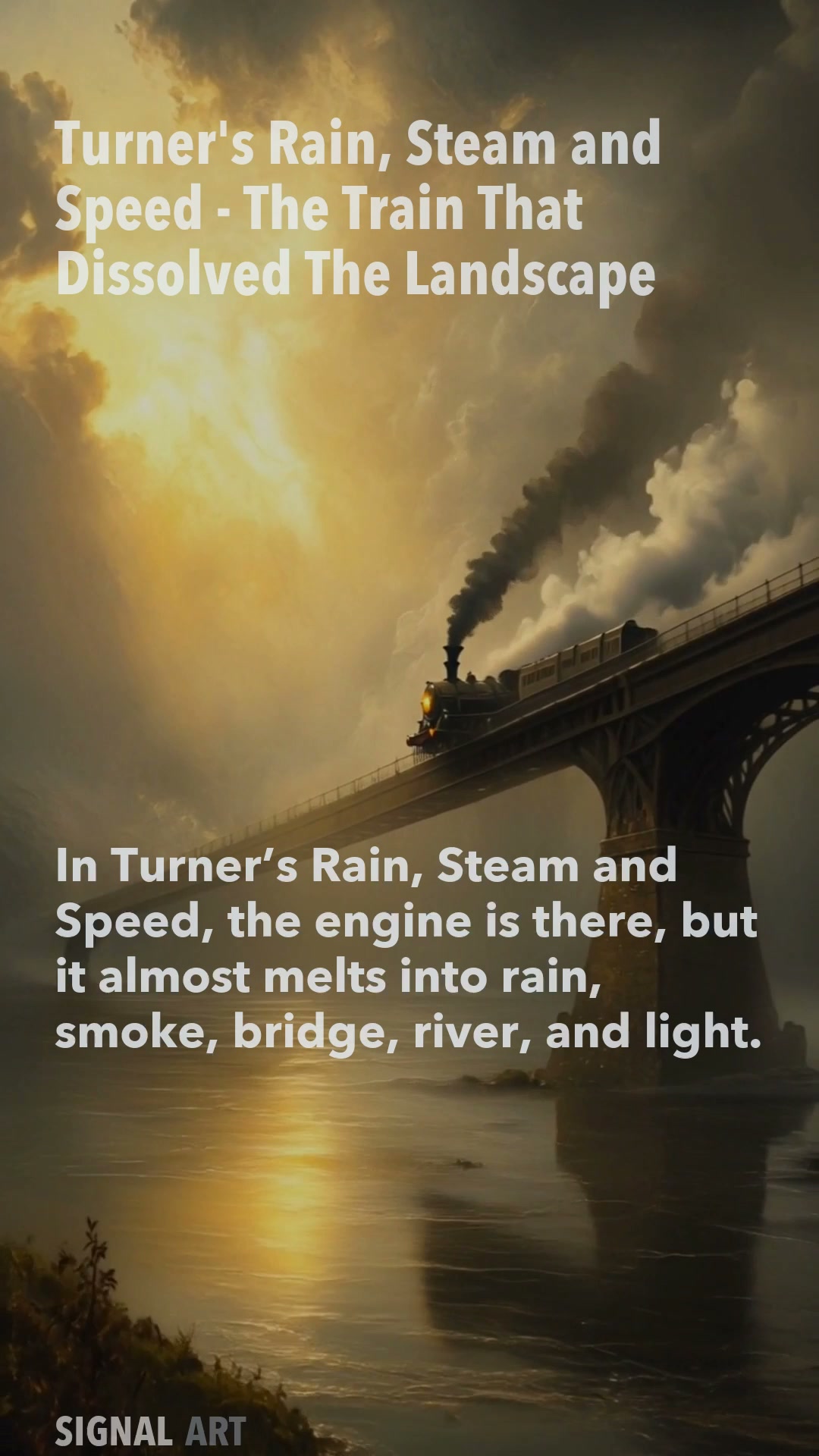
This folio expands the published Art video into a library record: the narrative spine, source trail, key still scenes, and reading path. The claim stays narrow: Wait, a train became weather? In Turner’s Rain, Steam and Speed, the engine is there, but it almost melts into rain, smoke, bridge, river, and light. Industry does not enter the landscape.
01What you see
The visual surface is the first piece of evidence, not decoration.
Wait, a train became weather? In Turner’s Rain, Steam and Speed, the engine is there, but it almost melts into rain, smoke, bridge, river, and light. Industry does not enter the landscape. It devours it.
02What it meant
The section keeps the video's core idea in written form.
That blur is the point. Turner uses loose brushwork, wet haze, and a hard diagonal bridge so your eye rushes forward. You do not inspect the machine calmly. You feel speed before photography could pin it still.
03Technique
The section keeps the video's core idea in written form.
In 1844, that feeling was new. Railways were remaking distance, and the Great Western line stood for that shock. Turner did not paint a neat machine portrait. He painted what modern travel did to human perception.
04Why it lasts
The section keeps the video's core idea in written form.
That is why the painting still matters. Modern technology becomes sublime here not through precision, but through overload. Turner shows the machine changing vision itself, which is why this image feels strangely contemporary instead of merely old.
05Sources
- Museum collection or official page - Rain, Steam and Speedmuseum
- Authoritative biography - J. M. W. Turnerreference
06Scene plates


07Further reading
As an Amazon Associate, Avaryn may earn from qualifying purchases.
- J. M. W. Turner: A Wonderful Range of Mind David Blayney Brown · intro
- Turner: The Painter of Light Franny Moyle · deep
- The Railway Journey: The Industrialization of Time and Space in the 19th Century Wolfgang Schivelbusch · extended