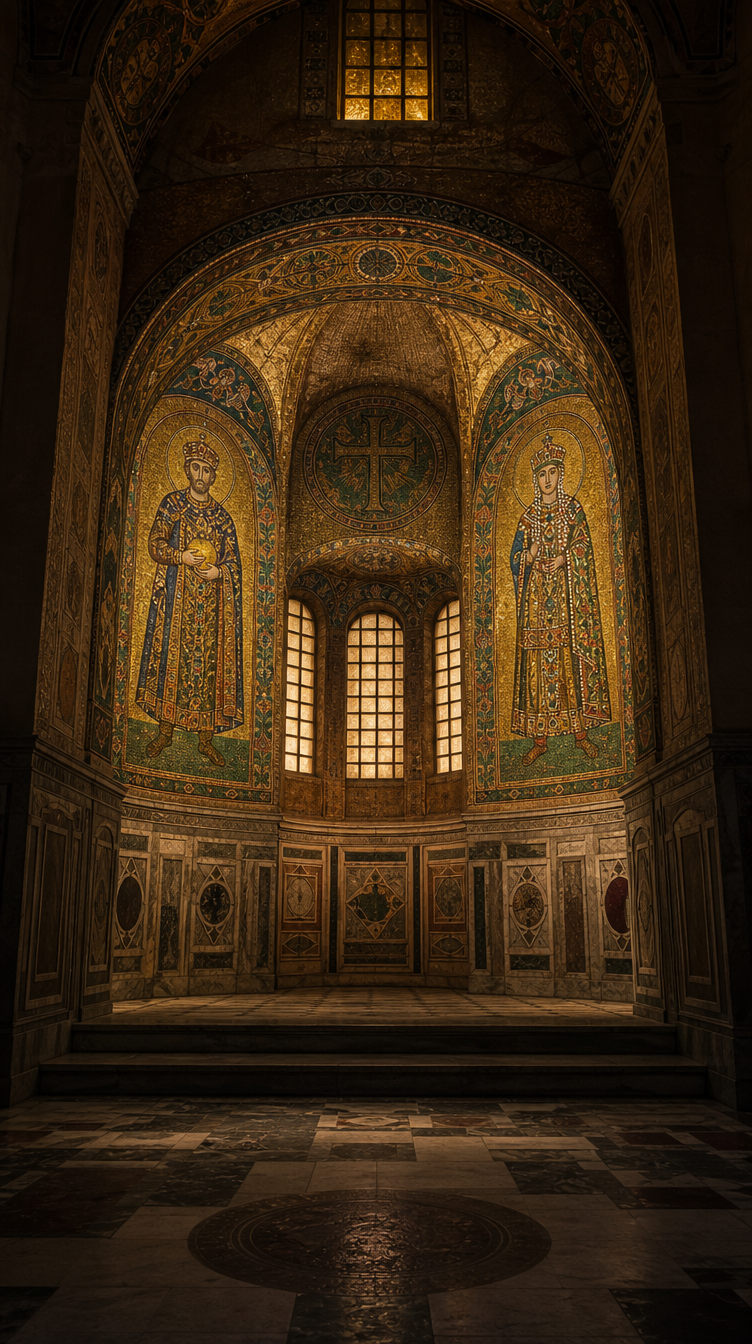
This folio expands the published Art video into a library record: the narrative spine, source trail, key still scenes, and reading path. The claim stays narrow: Why split them apart? In San Vitale, Justinian and Theodora face each other across the apse, not side by side. That distance is the message.
01What you see
The visual surface is the first piece of evidence, not decoration.
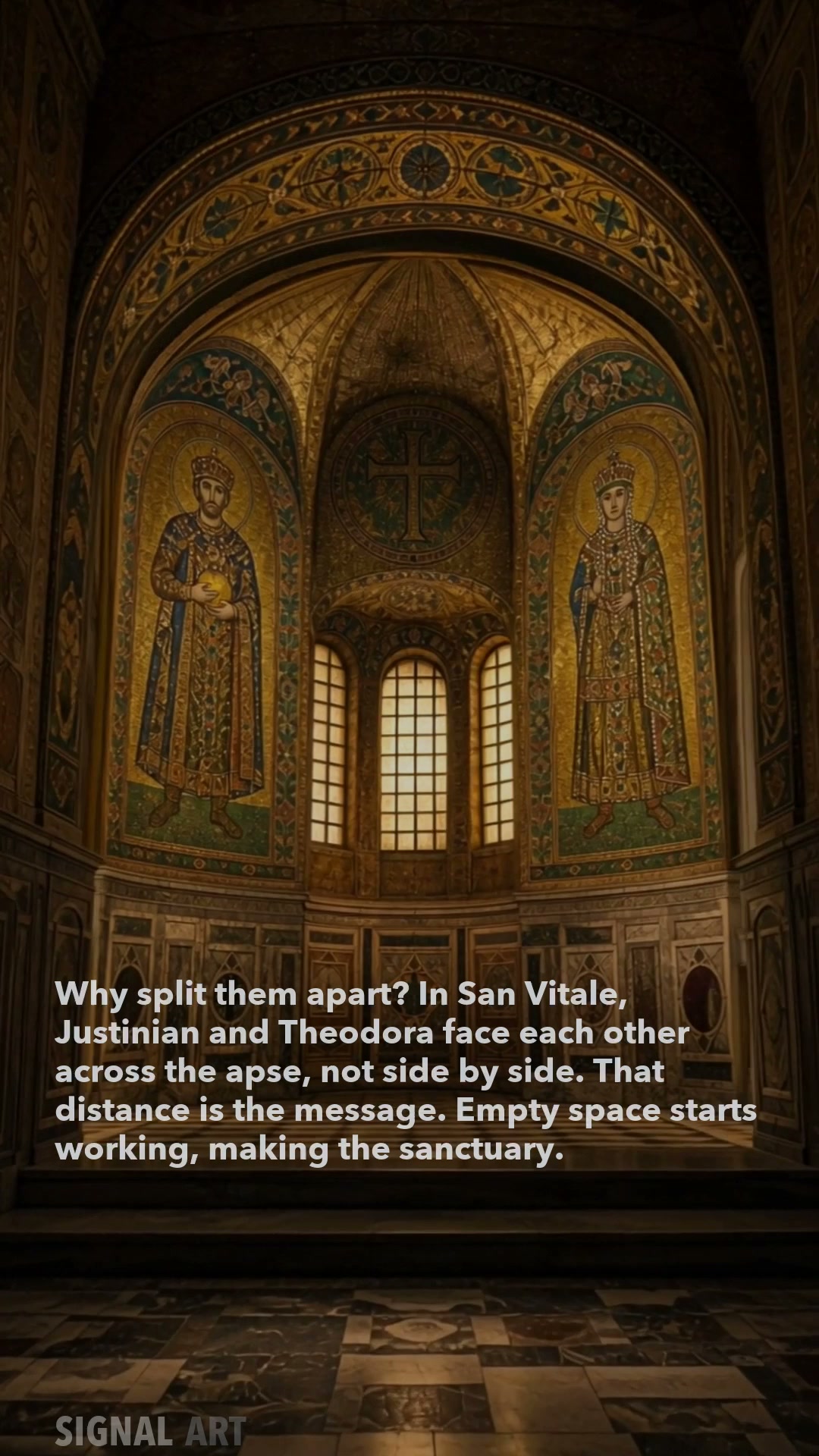
Why split them apart? In San Vitale, Justinian and Theodora face each other across the apse, not side by side. That distance is the message. Empty space starts working, making the sanctuary.
02What it meant
The section keeps the video's core idea in written form.
Look closer. Both courts resist normal motion. They hover against gold, frontal and nearly weightless, carrying ritual gifts. Nobody seems to enter or leave. The figures feel less like visitors than permanent.
03Technique
The section keeps the video's core idea in written form.
Then the mechanism clicks. One panel holds the emperor. The other holds the empress. Facing each other, they anchor the apse like twin weights of gold and stillness.
04Why it lasts
The section keeps the video's core idea in written form.
So these mosaics are not portraits beside worship. They reorganize worship itself. Imperial power appears as gold, stationary, and already built into the church. Once you notice that, the apse stops looking decorative.
05Sources
- Met Museumresearch_note
- MoMAresearch_note
- National Gallery of Artresearch_note
- Tateresearch_note
06Scene plates


07Further reading
As an Amazon Associate, Avaryn may earn from qualifying purchases.
- Byzantium: The Surprising Life of a Medieval Empire Judith Herrin · intro
- Ravenna in Late Antiquity Deborah Mauskopf Deliyannis · deep
- Art and Ceremony in Late Antiquity Sabine G. MacCormack · extended