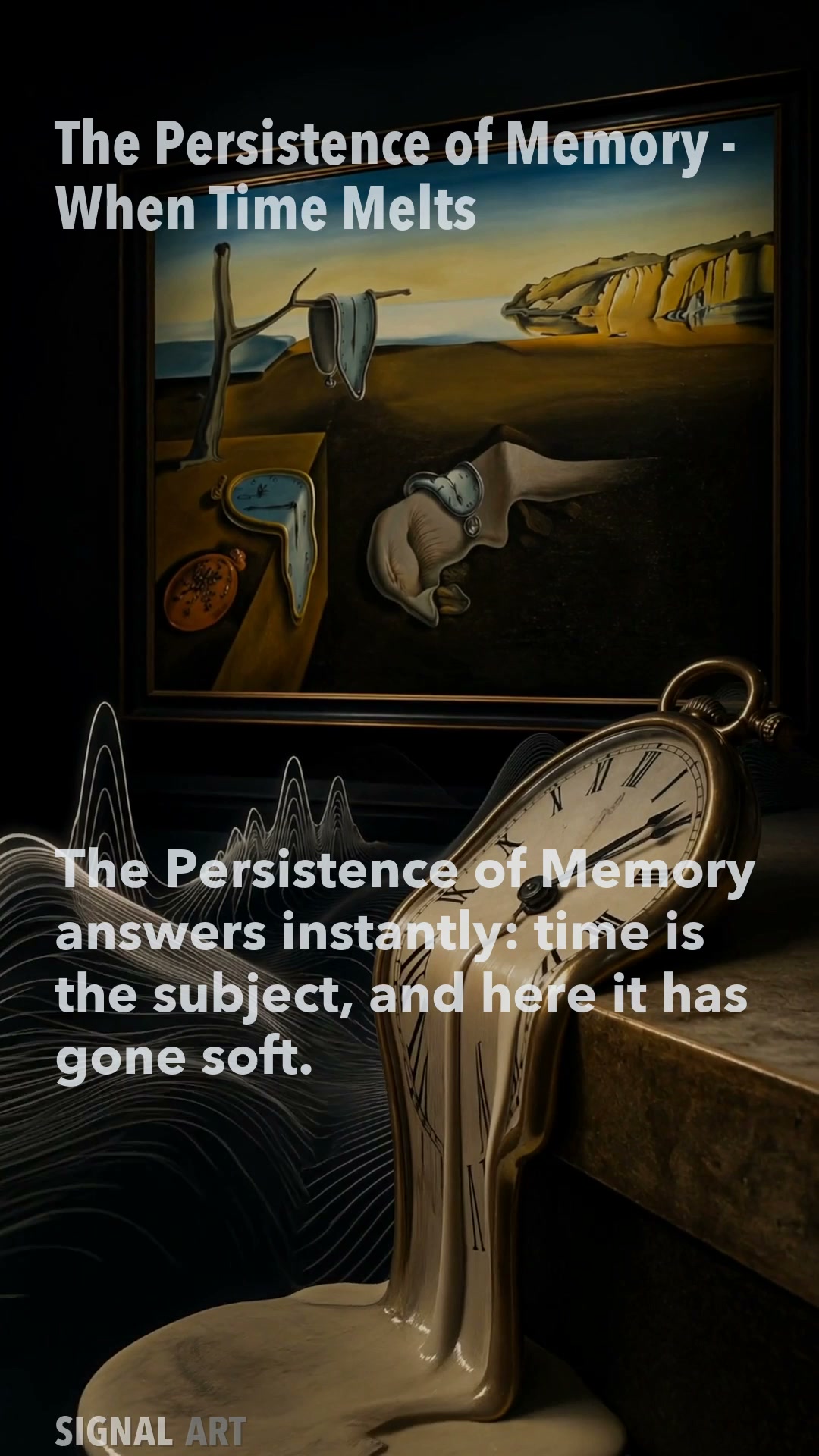
This folio expands the published Art video into a library record: the narrative spine, source trail, key still scenes, and reading path. The claim stays narrow: Why do Dali’s clocks melt? The Persistence of Memory answers instantly: time is the subject, and here it has gone soft. In this tiny 1931 painting, a still shoreline holds sagging watches like metal forgetting its own rules.
01What you see
The visual surface is the first piece of evidence, not decoration.
Why do Dali’s clocks melt? The Persistence of Memory answers instantly: time is the subject, and here it has gone soft. In this tiny 1931 painting, a still shoreline holds sagging watches like metal forgetting its own rules. The trick is realism.
02What it meant
The section keeps the video's core idea in written form.
The horizon stays steady. The shadows stay sharp. Stone, branch, sea, and light all look exact. Because the world behaves, the impossible watches feel less like fantasy and more like perception quietly breaking.
03Technique
The section keeps the video's core idea in written form.
So these clocks are not about machinery. They turn measurement into feeling: waiting, dreaming, grief, boredom, memory. In the mind, time stretches, collapses, and drifts. Dali gives that slippery inner experience one clean, unforgettable shape.
04Why it lasts
The section keeps the video's core idea in written form.
That is why this tiny image grew huge in culture. It does not just show a strange dream. It teaches something tougher: reality can look stable while the mind reshapes it underneath. Once you see that, those drooping clocks feel precise, not silly.
05Sources
06Scene plates


07Further reading
As an Amazon Associate, Avaryn may earn from qualifying purchases.
- The Story of Art E. H. Gombrich · intro
- Salvador Dalí Gilles Néret · deep
- The Interpretation of Dreams Sigmund Freud · extended