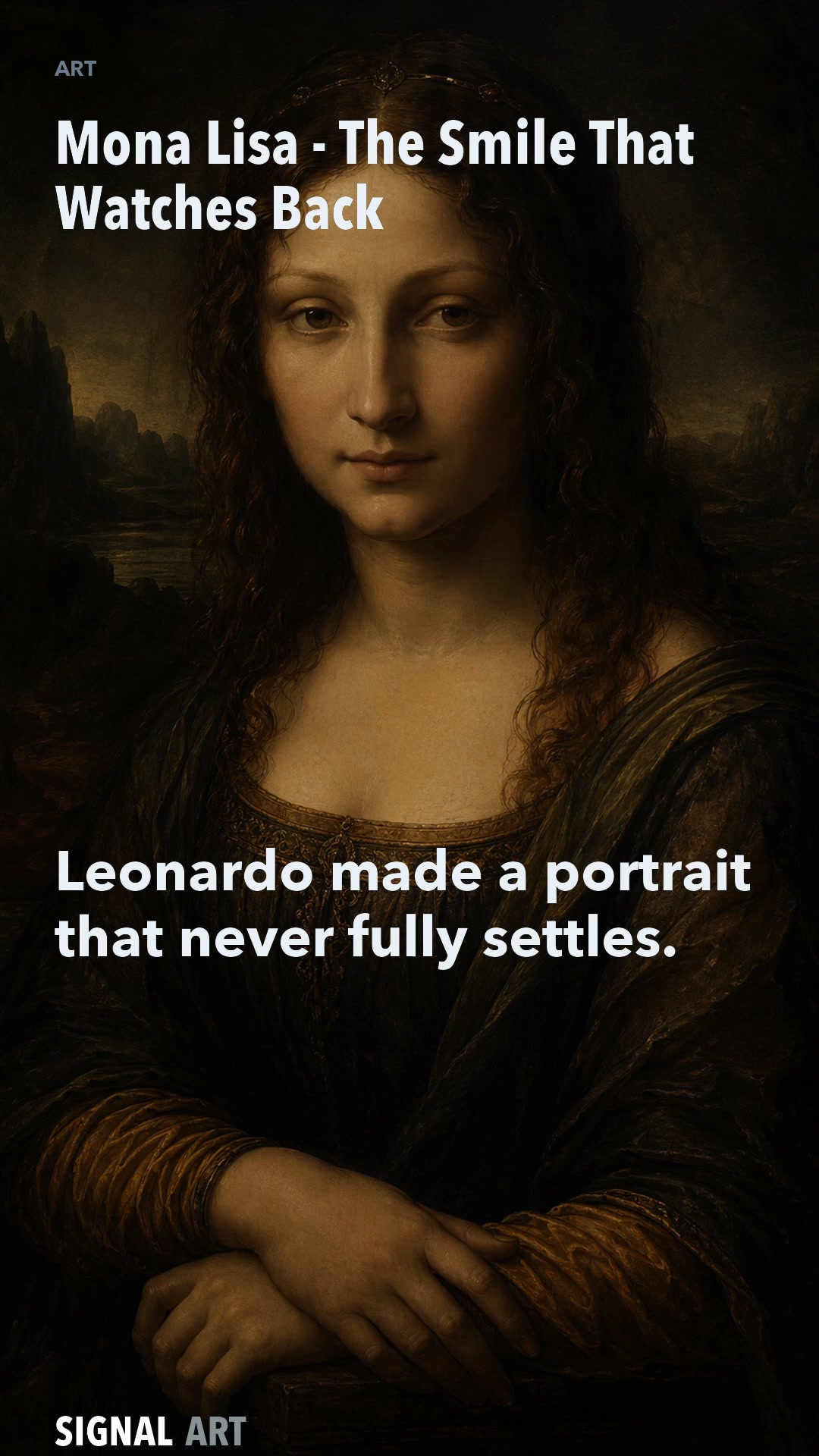
This folio expands the published Art video into a library record: the narrative spine, source trail, key still scenes, and reading path. The claim stays narrow: Why does the Mona Lisa feel alive? Leonardo made a portrait that never fully settles. The smile matters, but the deeper trick is stranger: her expression seems to change while your eyes keep checking it.
01What you see
The visual surface is the first piece of evidence, not decoration.
Why does the Mona Lisa feel alive? Leonardo made a portrait that never fully settles. The smile matters, but the deeper trick is stranger: her expression seems to change while your eyes keep checking it. Leonardo softened the mouth and eyes with sfumato, a smoky blur of tone instead of hard edges.
02What it meant
The section keeps the video's core idea in written form.
Nothing locks into place. From different distances, light, and focus, her mood slides between calm, amused, and remote. That instability changes the whole portrait.
03Technique
The section keeps the video's core idea in written form.
She stops feeling like a frozen likeness and starts feeling like a mind behind a face. The painting stays still, yet your perception keeps rewriting what she means. That is why the Mona Lisa changed portraiture.
04Why it lasts
The section keeps the video's core idea in written form.
It made ambiguity the main event. In Paris, people still do not just view it. They test it, waiting for a painted face to answer back.
05Sources
- Louvre - Mona Lisamuseum
- Britannica - Mona Lisareference
06Scene plates


07Further reading
As an Amazon Associate, Avaryn may earn from qualifying purchases.
- Leonardo da Vinci Walter Isaacson · intro
- Mona Lisa: The People and the Painting Donald Sassoon · deep
- Art and Illusion: A Study in the Psychology of Pictorial Representation E. H. Gombrich · extended