This folio expands the published Art video into a library record: the narrative spine, source trail, key still scenes, and reading path. The claim stays narrow: Why does The Great Wave move? Hokusai makes a print act like an accident. Around 1830, sea, boats, and Mount Fuji lock into one split second, so a still picture hits like action.
01What you see
The visual surface is the first piece of evidence, not decoration.
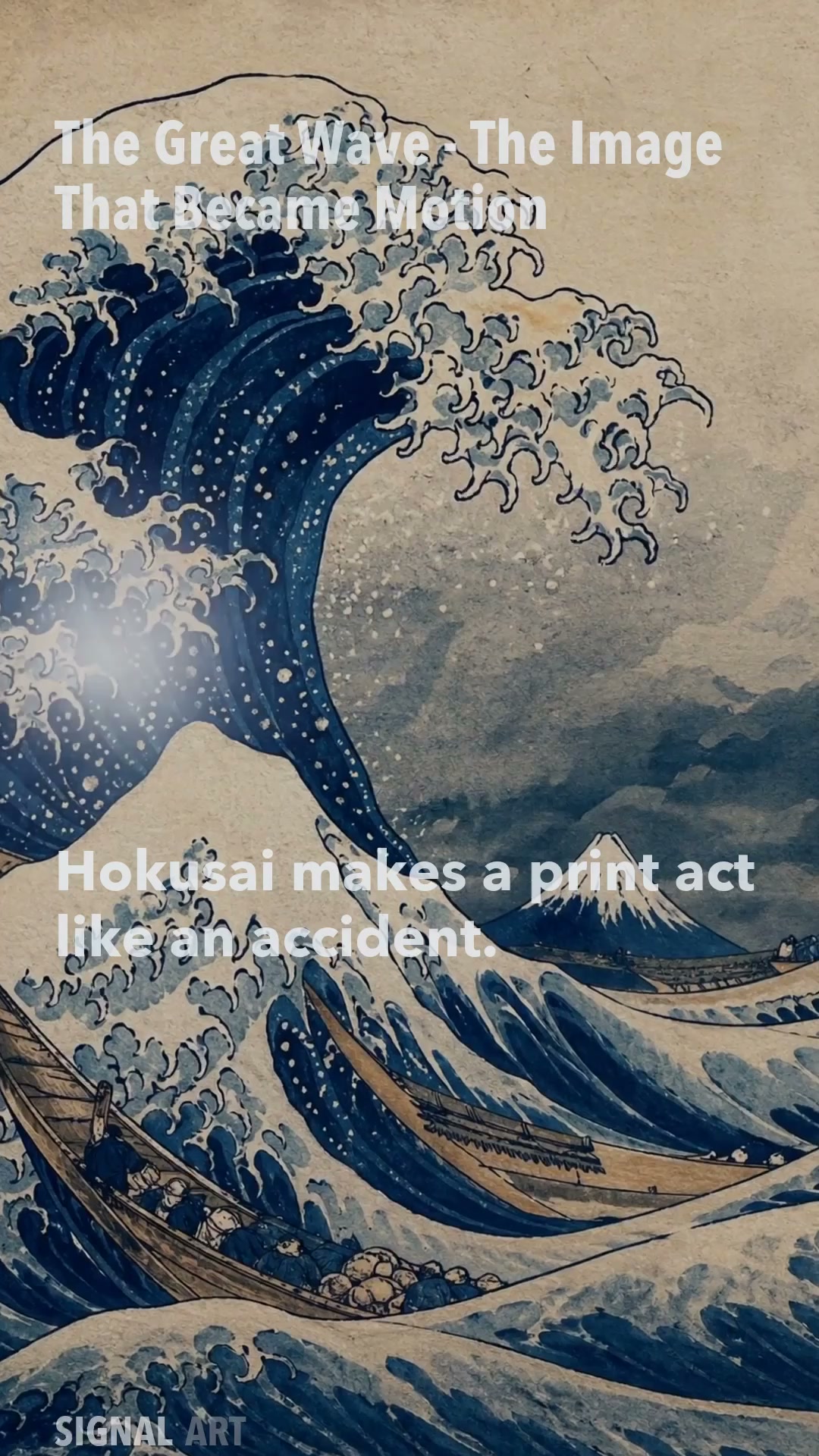
Why does The Great Wave move? Hokusai makes a print act like an accident. Around 1830, sea, boats, and Mount Fuji lock into one split second, so a still picture hits like action. The trick starts with scale.
02What it meant
The section keeps the video's core idea in written form.
Mount Fuji should dominate, but Hokusai shrinks it into calm distance while the wave towers overhead. The mountain feels fixed. The water suddenly steals the job of permanence.
03Technique
The section keeps the video's core idea in written form.
Then comes the snap. The curve drags your eye forward, foam splits into clawlike fingers, and the boats lean inside the arc. Nothing moves, yet every line stores momentum and points toward collapse. That is why it still feels modern.
04Why it lasts
The section keeps the video's core idea in written form.
Prussian blue deepens the shock, and the whole design compresses danger into one clean silhouette. The Great Wave is not just a landscape. It teaches you how pictures move.
05Sources
06Scene plates


07Further reading
As an Amazon Associate, Avaryn may earn from qualifying purchases.
- Hokusai: One Hundred Views of Mount Fuji Henry D. Smith II · intro
- Hokusai Gian Carlo Calza · deep
- The Great Wave: Price, Art, and the Routes of Modernity Christopher Benfey · extended