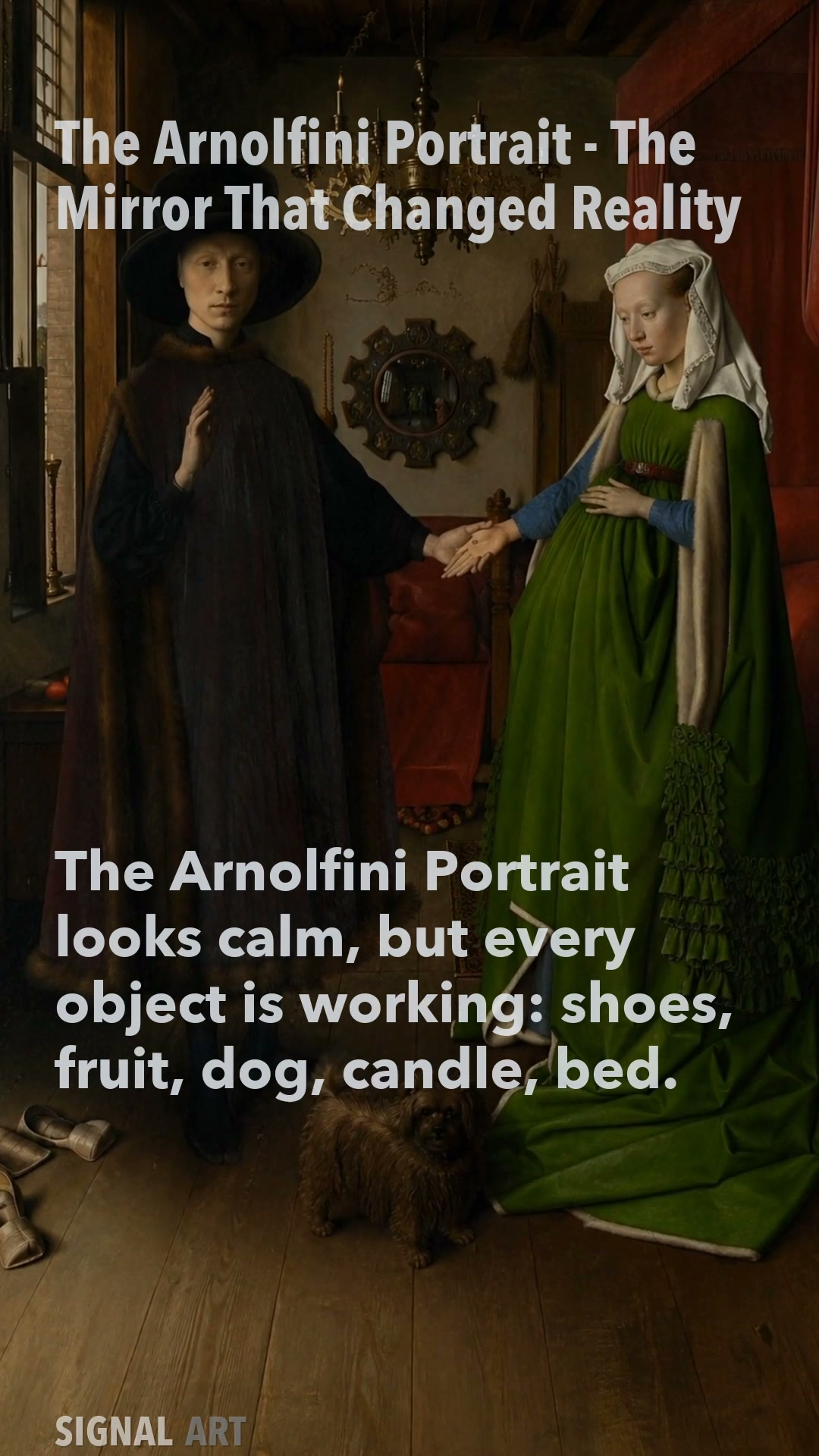
This folio expands the published Art video into a library record: the narrative spine, source trail, key still scenes, and reading path. The claim stays narrow: Wait, this room changed reality. The Arnolfini Portrait looks calm, but every object is working: shoes, fruit, dog, candle, bed. Two figures barely move, yet the whole space feels loaded, like a scene hiding testimony.
01What you see
The visual surface is the first piece of evidence, not decoration.
Wait, this room changed reality. The Arnolfini Portrait looks calm, but every object is working: shoes, fruit, dog, candle, bed. Two figures barely move, yet the whole space feels loaded, like a scene hiding testimony. That works because Jan van Eyck makes matter believable. Fur looks soft.
02What it meant
The section keeps the video's core idea in written form.
Glass bites with light. Wood, brass, and cloth feel touchable. Detail is not decoration here. It makes the room feel trustworthy, almost harder to question.
03Technique
The section keeps the video's core idea in written form.
Then the convex mirror flips everything. It shows the room from behind and two tiny figures near the door. Suddenly this is not one view anymore. The painting contains another witness, tucked inside the scene itself.
04Why it lasts
The section keeps the video's core idea in written form.
That is why it mattered. The picture becomes symbol, illusion, and record at once. It does not just show a room. It suggests presence itself can be painted, which is still how powerful images convince us they are true.
05Sources
06Scene plates


07Further reading
As an Amazon Associate, Avaryn may earn from qualifying purchases.
- The Story of Art E. H. Gombrich · intro
- Early Netherlandish Painting: Its Origins and Character Erwin Panofsky · deep
- The Art of Describing: Dutch Art in the Seventeenth Century Svetlana Alpers · extended