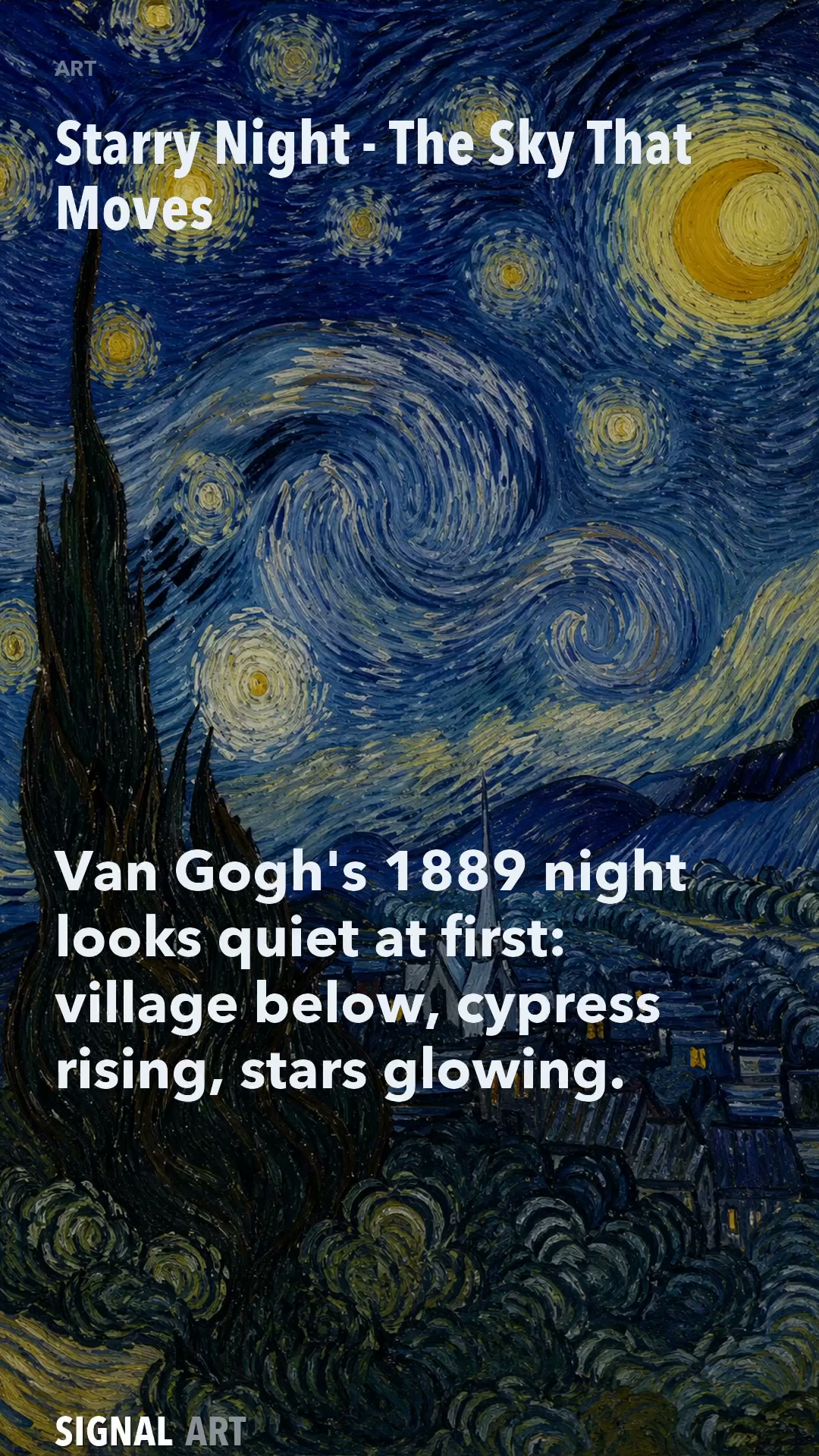
This folio expands the published Art video into a library record: the narrative spine, source trail, key still scenes, and reading path. The claim stays narrow: Wait, Starry Night is not calm. Van Gogh's 1889 night looks quiet at first: village below, cypress rising, stars glowing. Then the shock lands.
01What you see
The visual surface is the first piece of evidence, not decoration.
Wait, Starry Night is not calm. Van Gogh's 1889 night looks quiet at first: village below, cypress rising, stars glowing. Then the shock lands. The whole sky seems to move, as if darkness itself has currents.
02What it meant
The section keeps the video's core idea in written form.
That feeling is built, not borrowed from nature. Van Gogh bends the air with curved brushstrokes. Blue arcs push against yellow halos. The stars do not just shine.
03Technique
The section keeps the video's core idea in written form.
They pulse, and the paint makes you feel it. It gets deeper. He painted it in Saint-Remy during a brutal period, so the view is never pure observation. It is seen, remembered, and transformed.
04Why it lasts
The section keeps the video's core idea in written form.
The landscape becomes a pressure chamber where feeling hardens into shape. That is why the painting still hits. It makes inner experience visible without putting a person in the center. Once you notice the sky as motion, modern art clicks: landscape stops describing the world and starts revealing a mind.
05Sources
06Scene plates
07Further reading
As an Amazon Associate, Avaryn may earn from qualifying purchases.
- Van Gogh: The Life Steven Naifeh and Gregory White Smith · intro
- Van Gogh and the Colors of the Night Sjraar van Heugten and Joachim Pissarro · deep
- Concerning the Spiritual in Art Wassily Kandinsky · extended