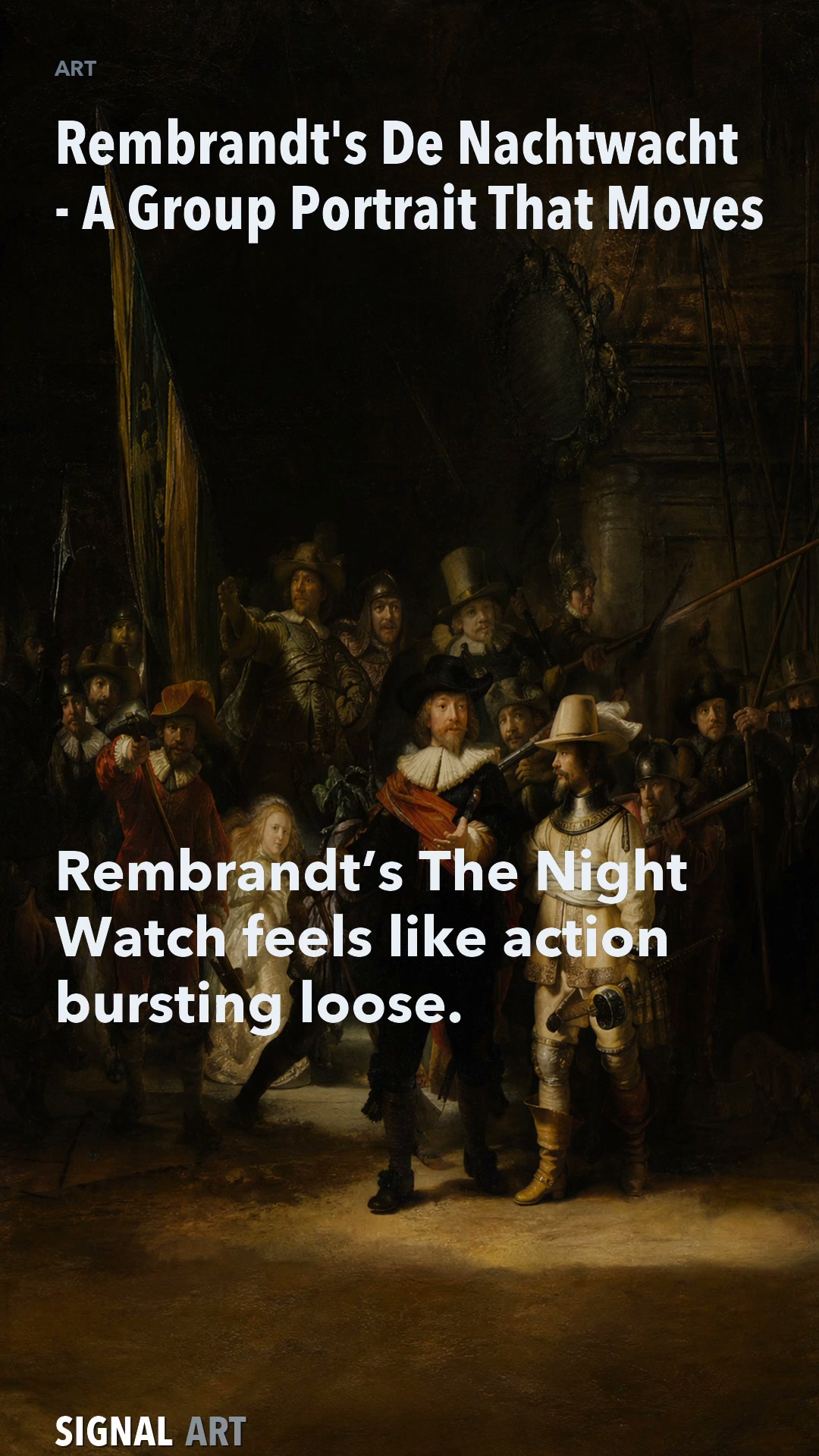
This folio expands the published Art video into a library record: the narrative spine, source trail, key still scenes, and reading path. The claim stays narrow: Wait, this was a portrait? Rembrandt’s The Night Watch feels like action bursting loose. It was a civic guard commission, but he flips the genre fast, making status feel unstable, public, and suddenly alive.
01What you see
The visual surface is the first piece of evidence, not decoration.
Wait, this was a portrait? Rembrandt’s The Night Watch feels like action bursting loose. It was a civic guard commission, but he flips the genre fast, making status feel unstable, public, and suddenly alive. Earlier group portraits often worked like roll call. Everyone was clear, balanced, and still.
02What it meant
The section keeps the video's core idea in written form.
Rembrandt breaks that habit with light. Faces flash out, lace glows, armor bites the dark, and the leaders seem to stride forward. Then the diagonals start pulling. Muskets tilt.
03Technique
The section keeps the video's core idea in written form.
Hands signal. A flag lifts upward. Bodies turn in different directions at once. It feels chaotic, but the chaos is controlled, so your eye keeps traveling through the company.
04Why it lasts
The section keeps the video's core idea in written form.
That is why The Night Watch mattered. It does not just record who paid to be seen. It stages power as performance. Rembrandt turned a lineup into public drama, and once you notice that, the painting never stands still again.
05Sources
- Rijksmuseum - The Night Watchmuseum
- Britannica - Rembrandtreference
06Scene plates


07Further reading
As an Amazon Associate, Avaryn may earn from qualifying purchases.
- Rembrandt's Eyes Simon Schama · intro
- Rembrandt: The Painter at Work Ernst van de Wetering · deep
- The Logic of the Gaze: Art, Modernity, and Optics Hubert Damisch · extended