This folio expands the published Art video into a library record: the narrative spine, source trail, key still scenes, and reading path. The claim stays narrow: Strange question: why does Nighthawks feel trapped? Hopper paints a glowing diner in 1942, yet the warmest spot on the block feels sealed. You can see comfort perfectly.
01What you see
The visual surface is the first piece of evidence, not decoration.
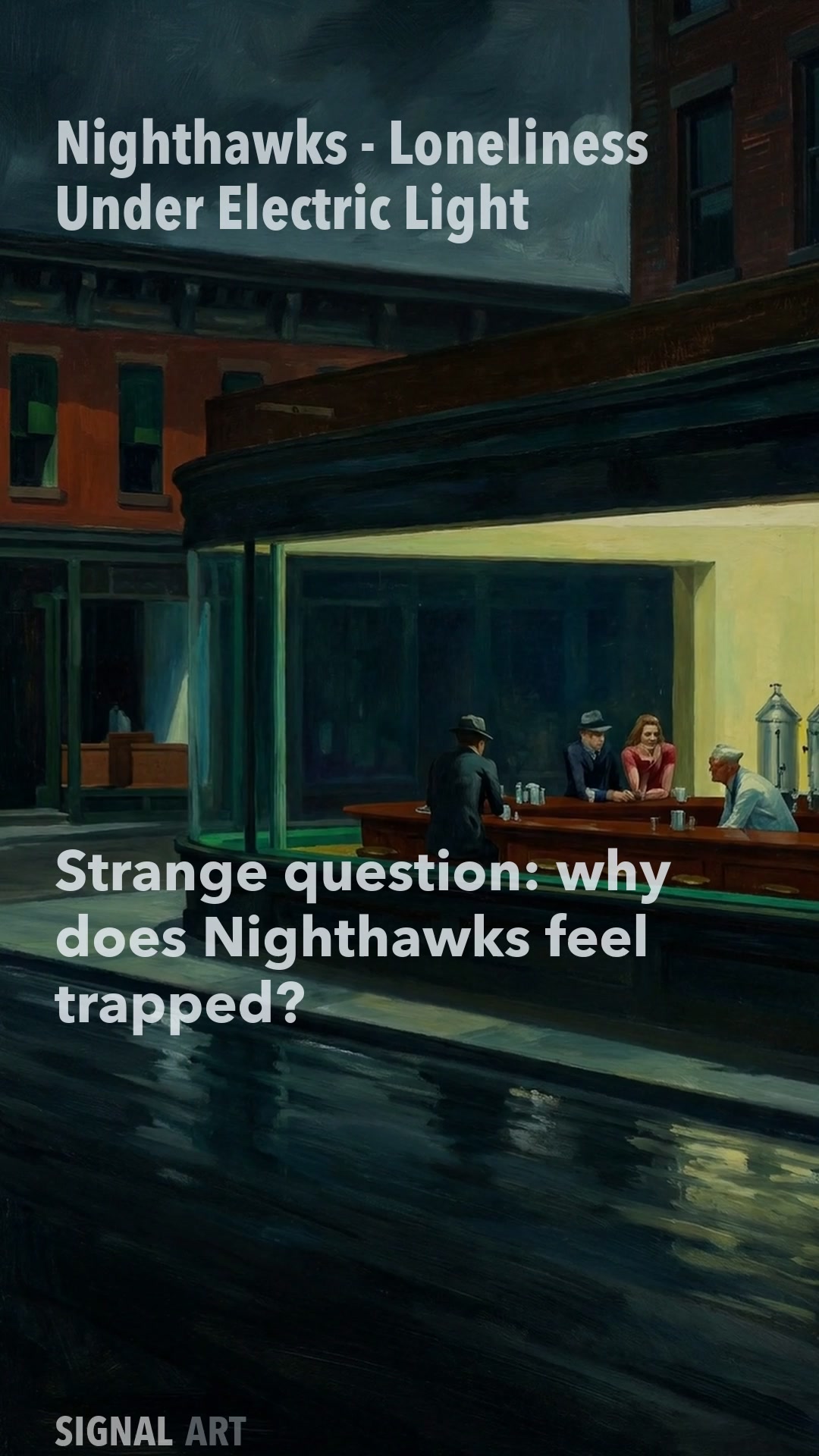
Strange question: why does Nighthawks feel trapped? Hopper paints a glowing diner in 1942, yet the warmest spot on the block feels sealed. You can see comfort perfectly. You just cannot enter it. Then Hopper tightens it.
02What it meant
The section keeps the video's core idea in written form.
The glass curves like an aquarium wall. There is no obvious door. Nobody leans or waves. Electric light reveals everything while quietly turning each person into a separate island.
03Technique
The section keeps the video's core idea in written form.
That is the trick. Hopper skips the crowd. People sit inches apart, yet the counter lines and empty street keep their silences from touching. Loneliness here is not mood alone. It is architecture.
04Why it lasts
The section keeps the video's core idea in written form.
That is why Nighthawks lasts. It does not just picture loneliness. It diagrams how a city can glow, expose, and still refuse contact. Once you spot that structure, modern life suddenly looks different everywhere.
05Sources
- Art Institute of Chicago - Nighthawksmuseum
- Britannica - Edward Hopperreference
06Scene plates


07Further reading
As an Amazon Associate, Avaryn may earn from qualifying purchases.
- The Age of Insight: The Quest to Understand the Unconscious in Art, Mind, and Brain, from Vienna 1900 to the Present Eric R. Kandel · intro
- Edward Hopper: An Intimate Biography Gail Levin · deep
- The Production of Space Henri Lefebvre · extended