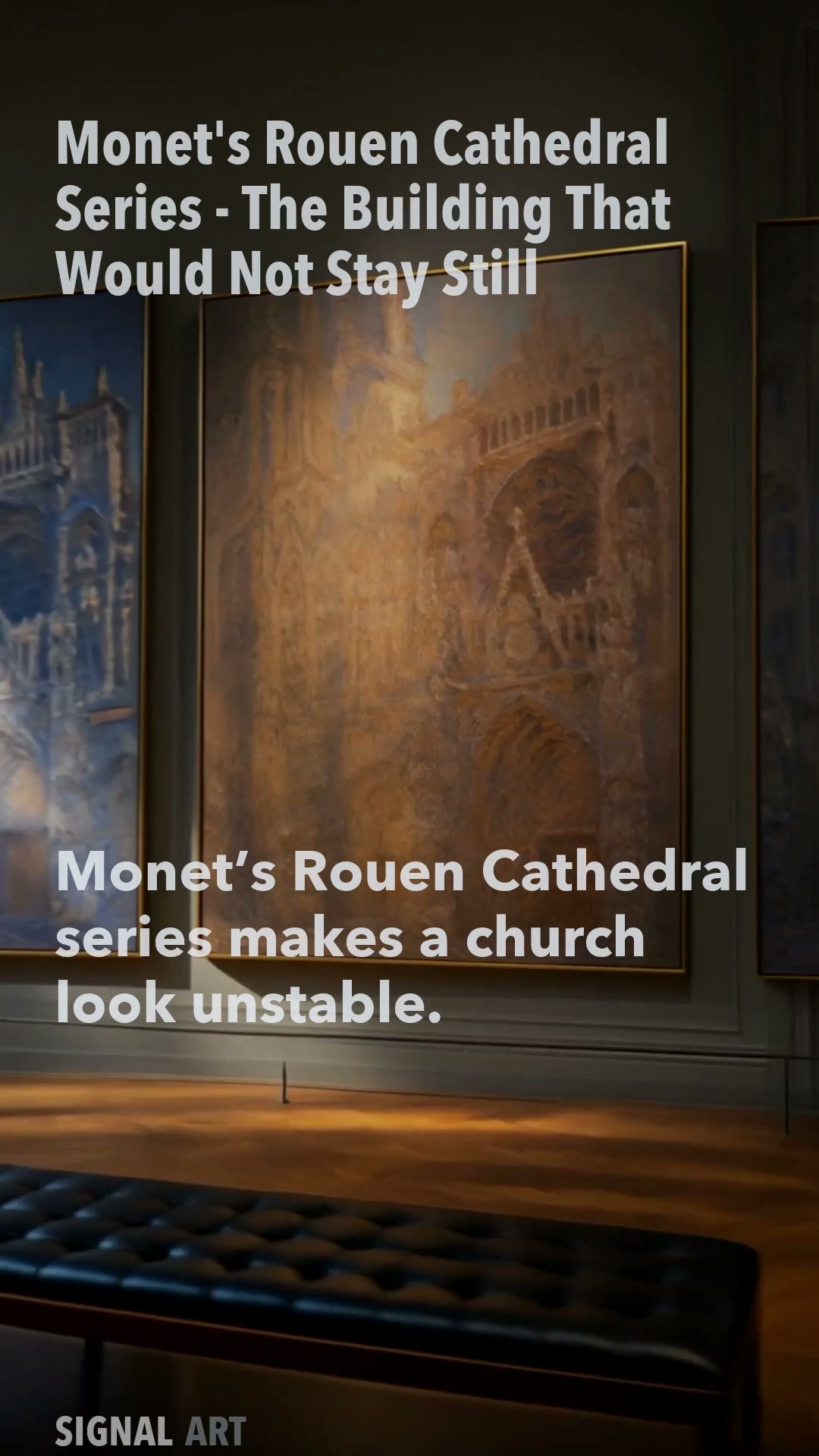
This folio expands the published Art video into a library record: the narrative spine, source trail, key still scenes, and reading path. The claim stays narrow: How can stone flicker? Monet’s Rouen Cathedral series makes a church look unstable. The facade seems to breathe because sun, haze, and shadow keep repainting it, turning heavy stone into something that feels almost like weather.
01What you see
The visual surface is the first piece of evidence, not decoration.
How can stone flicker? Monet’s Rouen Cathedral series makes a church look unstable. The facade seems to breathe because sun, haze, and shadow keep repainting it, turning heavy stone into something that feels almost like weather. The secret is repetition.
02What it meant
The section keeps the video's core idea in written form.
From 1892 to 1894, Monet painted the same facade again and again, not to pin it down, but to catch each hour changing the air around it. Up close, the method is blunt and brilliant. Broken brush marks and warm-cool color swaps replace hard outlines.
03Technique
The section keeps the video's core idea in written form.
Detail fades. Light thickens. Your eye assembles the cathedral from pulses of pigment instead of clean lines. That is why the series still matters.
04Why it lasts
The section keeps the video's core idea in written form.
Monet did not weaken the cathedral. He changed the subject from stone to seeing. The building stays put, but perception keeps moving, and now you can actually feel that shift.
05Sources
- Museum collection or official page - Rouen Cathedral Seriesmuseum
- Authoritative biography - Claude Monetreference
06Scene plates


07Further reading
As an Amazon Associate, Avaryn may earn from qualifying purchases.
- Monet: His Life and Works in 500 Images Susie Hodge · intro
- Monet: Nature into Art John House · deep
- The Painting of Modern Life: Paris in the Art of Manet and His Followers T. J. Clark · extended