This folio expands the published Art video into a library record: the narrative spine, source trail, key still scenes, and reading path. The claim stays narrow: Why does this painting feel dangerous? Caravaggio’s The Calling of Saint Matthew turns a miracle into an interruption. A beam slashes the room, fingers aim, and one tax collector looks less blessed than suddenly exposed.
01What you see
The visual surface is the first piece of evidence, not decoration.
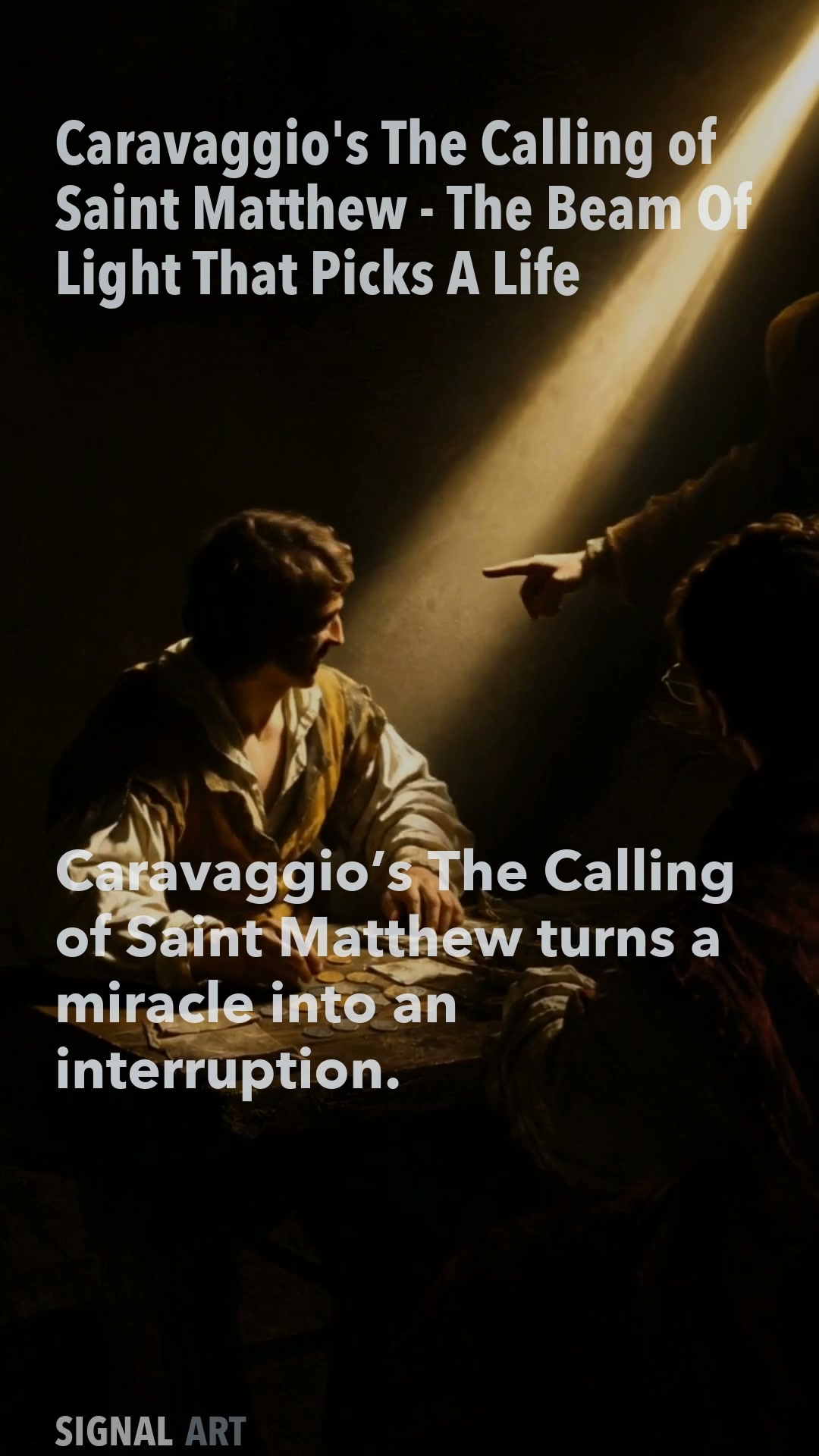
Why does this painting feel dangerous? Caravaggio’s The Calling of Saint Matthew turns a miracle into an interruption. A beam slashes the room, fingers aim, and one tax collector looks less blessed than suddenly exposed.
02What it meant
The section keeps the video's core idea in written form.
The shock comes from tenebrism, extreme dark against hard light, plus ordinary clothes and sharp hands. Nothing is distant or polished. The sacred event feels local, heavy, and close enough to stir the dust.
03Technique
The section keeps the video's core idea in written form.
Painted around 1599 to 1600 for the Contarelli Chapel in Rome, it helped define his religious naturalism. Sacred history drops into the same room as money, doubt, grime, and ordinary human hesitation. That is why the beam matters.
04Why it lasts
The section keeps the video's core idea in written form.
The miracle is not floating overhead. It arrives like light through a door, choosing a life in real time. Caravaggio changed art by making revelation feel brutally seen.
05Sources
- Museum collection or official page - The Calling of Saint Matthewmuseum
- Authoritative biography - Caravaggioreference
06Scene plates


07Further reading
As an Amazon Associate, Avaryn may earn from qualifying purchases.
- Caravaggio: A Life Sacred and Profane Andrew Graham-Dixon · intro
- Caravaggio Helen Langdon · deep
- The Social History of Art, Volume 2: Renaissance, Mannerism, Baroque Arnold Hauser · extended